.png)
Perth’s Top 7 Natural Stones for Benchtops: Which One Should You Choose for Your Kitchen?


In 2026, some of the best natural stones for benchtops include granite, marble, quartzite, limestone, travertine, dolomite, and soapstone. Each of these stones offers a unique balance of durability, aesthetics, and performance for modern kitchens.
Natural stones form over millions of years through geological processes such as volcanic activity, sedimentation, and metamorphic pressure. These natural forces create distinctive veining, colour variations, and mineral compositions in every slab. That is why no two natural stone benchtops are ever the same.
Thus, with so many options available, many homeowners ask the same question: which natural stone is best for kitchen benchtops?
The answer goes beyond appearance. Because each stone has different geological properties, the right choice depends on several practical factors, including scratch resistance, heat tolerance, porosity, maintenance requirements, and the level of daily use in your kitchen.
In this guide, you’ll explore the top natural stones for kitchen benchtops and understand their real strengths and limitations. We’ll compare their durability and maintenance requirements to help you determine which stone works best for your kitchen.
7 Best Natural Stones for Benchtops: Choose the Best One for Your Kitchen in 2026
Below are the top 7 types of natural stone benchtops in Perth. Each offers different advantages in terms of durability, maintenance, and visual appeal.
✅ Granite Benchtops – The Most Durable Natural Stone for Busy Kitchens

Granite is one of the most durable natural stones for benchtops. It’s a top choice for busy kitchens in Perth. Granite forms when molten magma cools slowly beneath the Earth's surface. This slow cooling process creates a dense crystalline structure composed of quartz, feldspar, and mica, which gives granite its incredible hardness and resistance to wear.
Because of this mineral composition, granite ranks around 6–7 on the Mohs hardness scale This makes it highly resistant to scratches from knives, cookware, and daily kitchen use. Granite also performs well under heat. Thus, it is commonly recommended as stone kitchen benchtops Perth homeowners use for heavy cooking.
Each slab features natural speckled patterns and mineral crystals that create unique designs ranging from deep black to warm earth tones and grey textures.
Pros and Cons of Granite Benchtops
Pros | Cons |
Extremely durable and scratch resistant Highly heat resistant Unique natural patterns and colours Long lifespan (can last decades) | Requires sealing to prevent stains Heavy slabs require professional installation Premium grades can be expensive |
Best for: busy family kitchens and high-traffic cooking spaces.
✅ Marble Benchtops – Luxury and Timeless Elegance

Marble has been associated with luxury architecture for centuries. It remains one of the most recognisable natural stones for benchtops. Marble forms when limestone undergoes intense heat and pressure deep within the earth, transforming into a crystalline stone rich in calcite.
This geological process creates the soft flowing veining patterns that marble is famous for.
Stones like Arabescato, Carrara, and Calacatta feature elegant white or cream backgrounds with dramatic veins that instantly elevate kitchen interiors.
However, because marble is composed primarily of calcite, it is softer and more chemically reactive than granite or quartzite. Acidic substances such as lemon juice, vinegar, and wine can cause etching if left on the surface for extended periods. Regular sealing helps protect the stone from stains and moisture penetration.
Despite its maintenance needs, marble remains one of the best natural stone options for luxury kitchens due to its unmatched aesthetic appeal.
Pros and Cons of Marble Benchtops
Pros | Cons |
Luxurious appearance and timeless style Unique natural veining patterns Increases property value Ideal for statement kitchen islands | Softer stone prone to scratches Can etch from acidic foods Requires regular sealing Higher maintenance needed |
Best for: designer kitchens, statement islands, and homes prioritising aesthetics over heavy-duty use.
✅ Quartzite Benchtops – Marble Look with Granite-Level Strength

Quartzite is considered the best natural stone alternative to marble. It’s because it offers similar visual beauty with significantly greater durability. Quartzite forms when sandstone is exposed to intense heat and pressure within the earth's crust. This causes the quartz grains to fuse into an extremely hard metamorphic rock.
Because quartzite contains a high concentration of natural quartz crystals, it reaches 7 on the Mohs hardness scale. This hardness makes quartzite extremely resistant to scratches and heat. Quartzite also displays dramatic veining patterns and colour variations, including whites, greys, blues, and subtle gold tones.
Pros and Cons of Quartzite Benchtops
Pros | Cons |
Extremely hard and durable Resistant to scratches and heat Marble-like appearance Suitable for high-use kitchens | Premium slabs can be expensive Some varieties require sealing Limited colour availability Professional installation required |
Best for: homeowners who want marble aesthetics with granite-level durability.
✅ Limestone Benchtops – Soft, Natural Texture for Warm Kitchen Designs

Limestone is a sedimentary rock formed from compacted marine fossils and minerals over millions of years. Because of its geological origin, limestone contains subtle textures, fossil markings, and soft neutral tones. This gives kitchens a calm and organic appearance.
Compared with other types of natural stones, limestone is relatively soft and porous. This means it requires careful sealing and gentle cleaning to maintain its appearance.
Due to this porosity, limestone is more commonly used in low-traffic areas such as splashbacks, feature islands, or decorative surfaces rather than heavily used worktops. However, when properly sealed and maintained, limestone creates a beautiful natural aesthetic that complements minimalist, rustic, and Mediterranean-style kitchens.
Pros and Cons of Limestone Benchtops
Pros | Cons |
Soft, natural and earthy appearance Unique fossil textures Works well in rustic kitchen designs Neutral colours complement many styles | More porous than other stones Requires regular sealing Prone to scratches Better suited to lighter use areas |
Best for: decorative kitchen areas, feature islands, or homes seeking a natural earthy aesthetic
✅ Travertine Benchtops – Warm Natural Character for Rustic Kitchens

Travertine is a natural sedimentary stone formed by mineral deposits from hot springs and limestone caves. Over thousands of years, calcium carbonate builds up and creates the distinctive porous texture and layered patterns that make travertine unique.
This geological process produces a stone with small natural cavities and subtle colour variations, ranging from soft creams and beiges to warm silver and earthy browns. Because of these characteristics, travertine brings a natural warmth that suits Mediterranean, rustic, and classic kitchen designs.
Compared with other benchtop stones, travertine is softer and more porous. This means sealing is important to prevent moisture and food spills from penetrating the surface. Many travertine slabs are filled and polished during fabrication to improve durability while preserving their natural look.
When properly sealed and maintained, travertine can create beautiful natural stone benchtops that feel warm, textured, and inviting.
Pros and Cons of Travertine Benchtops
Pros | Cons |
Warm, earthy tones and natural texture Unique natural character Ideal for rustic or Mediterranean kitchens Works well with natural timber cabinetry | Porous surface requires sealing Softer than granite or quartzite Can chip or scratch if heavily used Requires regular maintenance |
Best for: rustic kitchens, Mediterranean-style homes, and decorative kitchen areas.
✅ Dolomite Benchtops – The Balanced Choice Between Marble and Granite
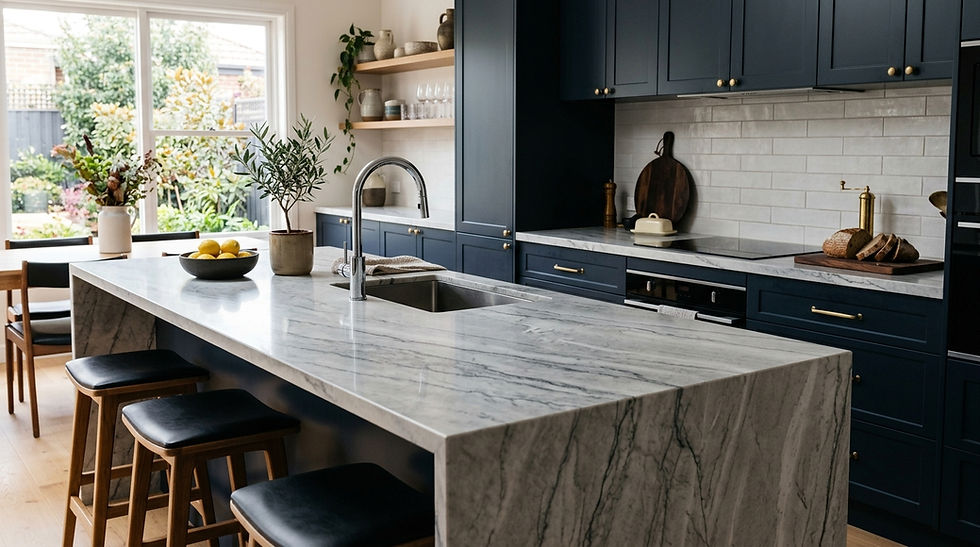
Dolomite is a natural sedimentary rock composed mainly of the mineral dolomite (calcium magnesium carbonate). It forms through geological processes where limestone undergoes mineral transformation over millions of years.
Visually, dolomite resembles marble. It features soft white backgrounds and elegant grey veining. But its mineral composition makes it slightly harder and more durable than traditional marble.
This balance between beauty and strength makes dolomite a growing favourite among homeowners searching for benchtop material that delivers a luxurious aesthetic.
While dolomite is more resistant to scratching and etching than marble, it is still considered a natural stone that benefits from sealing and careful cleaning. With the right maintenance, dolomite benchtops can provide a refined and elegant kitchen surface with improved durability.
Pros and Cons of Dolomite Benchtops
Pros | Cons |
Marble-like appearance with better durability More scratch-resistant than marble Elegant veining patterns Balanced option between beauty and strength | Requires sealing Less durable than granite Limited colour range Still sensitive to acidic spills |
Best for: homeowners who want marble aesthetics with improved durability.
✅ Soapstone Benchtops – Low-Maintenance Natural Stone with Classic Charm

Soapstone is a metamorphic rock composed mainly of talc and magnesium-rich minerals. Unlike many other natural stone types, soapstone is naturally non-porous. This means it does not absorb liquids and does not require sealing.
One of the defining characteristics of soapstone is its smooth matte surface and ability to develop a natural patina over time. As the stone ages, mineral oils and everyday use gradually deepen its colour. This gives it a rich and timeless appearance.
Soapstone is also highly resistant to heat and chemical reactions, making it a practical option for kitchens where hot cookware and cooking ingredients are frequently used. Although soapstone is softer than granite or quartzite, its surface can be easily repaired. Minor scratches can be sanded and blended into the stone's natural patina.
Pros and Cons of Soapstone Benchtops
Pros | Cons |
Naturally non-porous – no sealing required Highly heat resistant Develops attractive natural patina Easy to repair small scratches | Softer than granite Limited colour palette Scratches may appear over time Less common than other stones |
Best for: homeowners seeking low-maintenance natural stone benchtops with a classic, aged appearance and excellent heat resistance.
Comparing Natural Stones for Benchtops at a Glance
Natural Stone | Durability | Maintenance | Best For |
Granite | Very High | Medium (sealing required) | Busy family kitchens |
Marble | Medium | High maintenance | Luxury kitchen designs |
Quartzite | Very High | Low–Medium | Marble look with durability |
Limestone | Low–Medium | High maintenance | Decorative kitchen features |
Travertine | Medium | Medium maintenance | Rustic and Mediterranean kitchens |
Dolomite | Medium–High | Medium maintenance | Elegant modern kitchens |
Soapstone | Medium | Low maintenance | Classic and heat-resistant kitchens |
Natural stone is not the only option available in 2026. Many homeowners now consider engineered surfaces that mimic natural stone while offering additional durability.
So, let’s explore the modern alternatives to natural stones and how they compare to traditional stone surfaces.
Modern Engineered Alternatives to Natural Stone Benchtops
Engineered surfaces replicate stone looks while boosting performance. That is why porcelain and sintered stone are now common choices for stone kitchen benchtops in Perth. They’re manufactured from natural minerals, clays or stone powders under extreme heat and pressure to create very dense, low-porosity slabs that resist stains, UV and heat better than many quarried stones. Let’s dig them a bit deeper:
✅ Porcelain Slabs – High-Heat, Low-Maintenance Stone Look
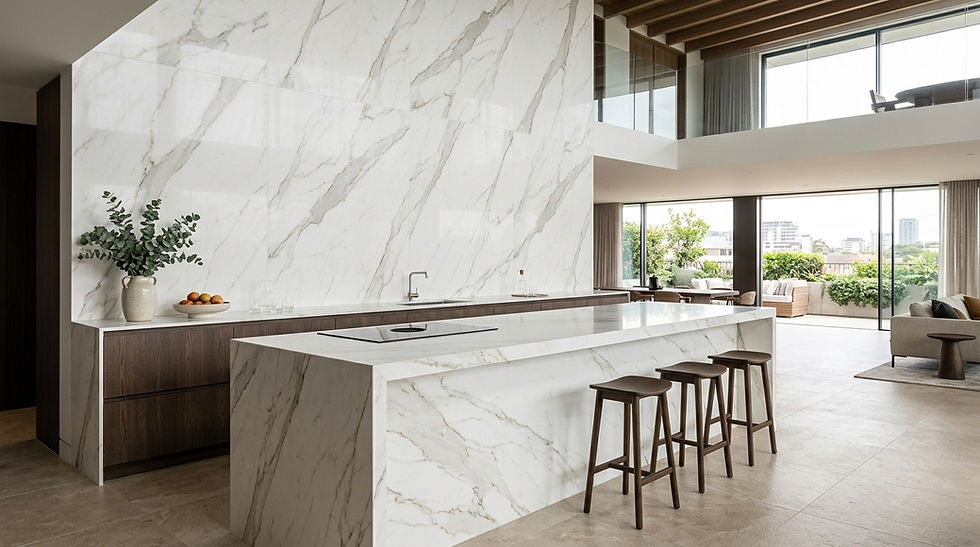
Porcelain slabs are large-format ceramics fired above 1200°C from refined clays and mineral pigments. The firing and vitrification process produces a non-porous, stain-resistant surface that can mimic marble, concrete or granite with consistent printed patterns. Porcelain’s UV stability also makes it a great option for alfresco kitchens in Perth.
Homeowners choose it for very low porosity, excellent stain/heat/scratch resistance, a wide design range, and outdoor suitability.
Quick pros/cons
Pros: Non-porous; heat, stain & scratch resistant; UV stable; versatile finishes.
Cons: Edge chipping risk; professional fabrication required; premium cost; cutting needs dust control.
Best for: busy kitchens, outdoor BBQ areas, and owners who want stone aesthetics with minimal upkeep.
✅ Sintered Stone Slabs – Ultra-Compact, High-Performance Surfaces

Sintered stone (ultra-compact) is made by fusing natural mineral powders under intense pressure and heat. The outcome is an extremely dense, almost impervious slab designed for heavy use and outdoor exposure.
Neolith (sintered mineral slab)
Neolith is a 100% mineral sintered product offering very low porosity, strong UV resistance and sleek thin profiles (3–12mm). It performs like natural stone but with fewer maintenance headaches.
Pros: Extremely durable, UV stable, wide finishes.
Cons: High cost, heavy slabs, professional handling and silica dust when cutting.
Dekton (ultra-compact composite)
Dekton mixes quartz, porcelain and glass to create an ultra-compact surface noted for exceptional heat and scratch resistance and low porosity. Ideal for direct outdoor exposure.
Pros: Superb heat & scratch resistance; UV stable; low porosity.
Cons: Premium price, very heavy, specialist installation; hard to repair.
These engineered options bridge stone aesthetics with commercial-grade durability. Next, let’s look at real natural stones prices so you can compare cost vs performance.
Natural Stone Benchtop Cost in Perth (2026 Price Guide)
In Perth, natural stone benchtops typically cost between $600 and $2,500+ per square metre installed, depending on the stone type, slab quality, and installation complexity.
Prices vary based on the specific benchtop stone, slab rarity, fabrication requirements, and site access. Below are typical installed price ranges for natural stone benchtops Australia homeowners can expect in 2026.
Granite: $600 – $2,000 per m² installed
Marble: $700 – $2,500 per m² installed
Quartzite: $800 – $1,800 per m² installed
Limestone: $400 – $1,800 per m² installed
Travertine: $700 – $2,000+ per m² installed
Dolomite: $600 – $1,300+ per m² installed
Soapstone: $1,000 – $2,500+ per m² installed
Several factors influence the final cost of stone benchtops for kitchen:
Premium slab grade or rare colours
Waterfall edges or mitred edge profiles
Sink and cooktop cut-outs
Slab thickness and reinforcement
Installation complexity and site access
For accurate pricing, it is always best to visit a showroom and request a detailed quote.
Conclusion: Which Natural Stone Kitchen Benchtop Wins?
There’s no single “winner”. The best natural stone for kitchen benchtops depends on how you live and what you value most.
Choose granite or quartzite if durability and low-maintenance performance for a busy Perth family kitchen matter most.
Choose marble or dolomite if you want a high-end, show-stopping island and can accept extra care.
Choose soapstone if you want a low-maintenance, heat-tolerant surface that ages beautifully.
Choose travertine or limestone for rustic or Mediterranean looks in lower-traffic areas.
Consider porcelain or sintered stone (Neolith, Dekton) when you want stone aesthetics plus ultra-low porosity and outdoor performance.
Make the decision by matching stone properties (hardness, porosity, UV stability) to your daily use, budget, and design goals. Visit full slabs in real light. Ask about sealing and warranty. And get a local, itemised quote before committing. That’s the easiest way to avoid buyer’s regret.
Ready to pick the perfect benchtop for your Perth kitchen? Worried you’ll choose a benchtop that chips, stains, or needs constant resealing?
Find the Perfect Natural Stone Benchtop for Your Kitchen at Master Tops
At Master Tops, our experienced team helps Perth homeowners compare different natural stone benchtops, explore full slab selections, and understand the durability, maintenance, and design benefits of each material.
Whether you’re renovating a kitchen, bathroom, or laundry, we’ll guide you toward a surface that balances beauty, durability, and long-term value.
With a wide range of premium natural stones and modern surfaces available in our showroom, you can confidently choose the perfect benchtop that enhances both the functionality and style of your home.
FAQs
What is the most durable natural stone for benchtops?
Granite and quartzite are the most durable natural stones. Both resist scratches, heat, and heavy daily use far better than softer options like marble or limestone, making them top picks for busy kitchens.
Is marble a good choice for kitchen benchtops?
Yes, if you prioritise luxury looks and are willing to accept higher maintenance. Marble gives unmatched elegance but is softer and more prone to etching and staining, so it needs careful cleaning and regular sealing to keep its appearance.
Are natural stone benchtops expensive?
Costs vary widely. Expect roughly $600–$2,500+/m² installed in Perth, depending on stone type, slab grade, and installation complexity. Premium marbles and rare quartzites sit at the top end, while common granites and some limestones start lower.
Granite vs marble vs quartzite — which is best for busy kitchens?
Choose granite or quartzite for busy kitchens. Both combine heat resistance and scratch resistance with manageable maintenance, whereas marble is more suited to low-traffic or feature areas.
Do natural stone benchtops need sealing?
Many do, especially marble, limestone, and travertine. Sealing reduces staining risk. Soapstone and some hard quartzites may not require regular sealing.
What stone is best for outdoor benchtops?
Pick low-porosity, UV-stable surfaces like sintered stone (Neolith), Dekton, porcelain slabs, or select granites. These materials resist fading and weathering and are ideal for Perth alfresco kitchens.
What is the cheapest natural stone countertop?
Granite is generally the most affordable natural stone option. Because granite is widely quarried and available in many grades, you can find durable, attractive granite benchtops at a lower cost than premium marbles or rare quartzites.
What is the lowest maintenance benchtop option?
Engineered quartz and porcelain slabs are among the lowest maintenance choices. They are non-porous, rarely need sealing, and clean easily.


Comments